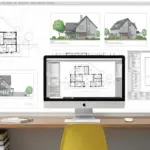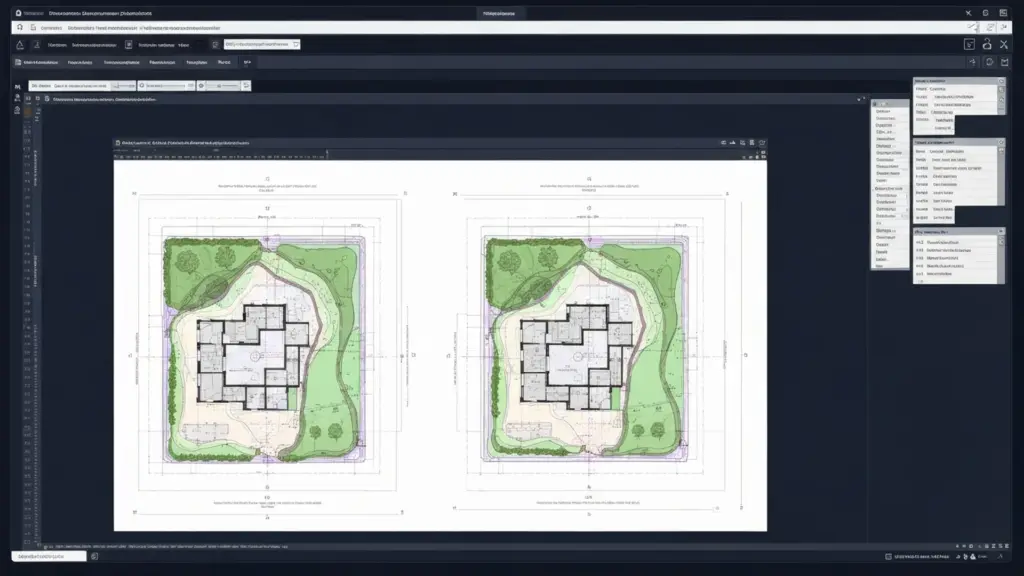
If you are planning a home extension, new dwelling, granny flat, subdivision, or any development that requires council approval in Australia, you will need DA drawings. Development application drawings are the set of architectural and site plans submitted to your local council to demonstrate that your proposed development meets planning controls, zoning requirements, and the National Construction Code (NCC).
This guide explains exactly what DA drawings are, what they include, who prepares them, how long the process takes, and what it costs in 2026.
What Are DA Drawings?
DA drawings (development application drawings) are a set of scaled architectural plans and supporting documentation submitted to a local council or planning authority as part of a development application. They demonstrate the design intent of your proposed works and show compliance with applicable planning controls including setbacks, height limits, site coverage, floor space ratio, and heritage overlays.
DA drawings are distinct from construction certificate (CC) drawings, which come later and contain full structural and engineering detail needed to build. DA drawings focus on design compliance; CC drawings focus on construction detail.
What Do DA Drawings Include?
A standard set of DA drawings for a residential development in Australia typically includes:
Site plan
A scaled overhead plan showing the property boundary, proposed building footprint, setbacks from all boundaries, vehicle access, parking, landscaping, and any existing structures being retained or demolished.
Floor plans
Scaled plans of each level showing room layout, dimensions, door and window positions, floor areas, and intended use of each space. Floor plans demonstrate compliance with minimum room sizes, accessibility requirements (AS 1428), and natural light and ventilation requirements.
Elevations
Scaled drawings of each exterior face of the building showing the overall height, roof form, window and door positions, external materials, and finished ground level. Elevations are critical for demonstrating compliance with height limits and for councils assessing visual amenity and neighbourhood character.
Sections
Cross-sectional drawings cut through the building showing internal heights, floor-to-ceiling clearances, roof pitch, and the relationship between internal and external finished levels. Sections help councils assess bulk and scale, particularly on sloping sites.
Shadow diagrams
Most councils require shadow diagrams for two or more times of day on 21 June (winter solstice) to demonstrate that the proposed development does not unreasonably overshadow neighbouring properties or private open space.
Who Prepares DA Drawings in Australia?
DA drawings are typically prepared by a licensed building designer, registered architect, or a professional drafting company with experience in residential and commercial development applications. The key requirement is knowledge of your local planning controls including national planning legislation, state SEPPs, and your council’s LEP and Development Control Plan (DCP).
At Draftings Australia, our team prepares DA drawings for residential and commercial projects across Brisbane, Sydney, Melbourne, Perth, and Gold Coast. We work directly with councils and understand state-specific requirements including Queensland Development Code in QLD and SEPP Housing in NSW.
DA Drawings Australia: State by State
| State | Planning framework | Key reference |
|---|---|---|
| Queensland | Planning Act 2016, Queensland Development Code | Council planning scheme + State Planning Policy |
| New South Wales | Environmental Planning and Assessment Act 1979 | Local Environmental Plan (LEP) + Development Control Plan (DCP) |
| Victoria | Planning and Environment Act 1987 | Planning scheme + ResCode (Clause 54/55) |
| Western Australia | Planning and Development Act 2005 | Local Planning Scheme + R-Codes |
What Projects Need DA Drawings?
- New dwellings, dual occupancies, townhouses
- Home extensions and additions exceeding complying development thresholds
- Granny flats and secondary dwellings
- Demolition of existing structures
- Change of use (e.g. residential to commercial)
- Subdivisions and lot boundary adjustments
- Commercial developments requiring planning approval
- Developments in heritage conservation areas
How Long Does It Take to Prepare DA Drawings?
- Simple single-storey addition or granny flat: 5-10 business days
- New dwelling or dual occupancy: 10-15 business days
- Multi-storey or complex residential: 15-25 business days
- Commercial or mixed-use: 3-6 weeks depending on scope
Council DA processing times are separate. Most councils currently take 40-100 business days to determine a development application, though complying development through a private certifier can be approved in as little as 20 business days.
How Much Do DA Drawings Cost in Australia?
- Granny flat / secondary dwelling: the most economical DA set — a compact drawing package
- Single-storey extension: a step up, driven by how much of the existing dwelling must be documented
- New single dwelling: a full drawing set — site plan, floor plans, elevations, sections and shadow diagrams
- Dual occupancy / duplex: scales with the second dwelling and additional planning controls
- Townhouse / multi-dwelling: the largest packages, scaling with dwelling count and council requirements
Every project is quoted as a fixed price against your specific scope — drafting and documentation only, excluding council DA fees, engineer reports, surveying, or heritage assessments. Send your brief for an exact figure within 24 hours.
DA Drawings vs CC Drawings
- DA drawings – submitted to council for planning approval. Show design intent and compliance with planning controls.
- CC drawings – submitted after DA approval for a construction certificate. Include full structural and engineering detail required to build.
Both are required before construction can legally commence in most Australian states.
Do I need DA drawings for a granny flat?
In most Australian states, yes. A granny flat requires either a development application with full DA drawings, or can be approved as complying development under SEPP Housing (NSW) or equivalent state provisions. In Queensland, secondary dwellings under 80m2 may qualify as code assessable development under the Queensland Development Code. We can advise on the approval pathway for your property and prepare the drawings required.
Can I submit DA drawings myself?
You can submit a development application yourself in most states, but the drawings must meet council standards including scaled, dimensioned plans showing all required information. Councils regularly reject applications with inadequate drawings, adding months to your approval timeline. Using an experienced drafting professional who understands local planning controls significantly improves the quality of your application.
What scale do DA drawings need to be?
Australian councils typically require DA drawings at 1:100 for floor plans and elevations, with site plans at 1:200 or 1:500 depending on block size. All drawings must include a north point, scale bar, drawing number, revision history, and the property address. Our DA drawings comply with AS 1100.301 technical drawing standards and all relevant council submission requirements.
How long does DA approval take?
Most Australian councils are required to determine development applications within 40 business days (NSW) or equivalent statutory timeframes. In practice, straightforward residential DAs are often determined in 6-12 weeks; complex applications can take 4-6 months or longer. Submitting a complete application with thorough DA drawings is the single biggest factor in minimising delays.
Do DA drawings need to show shadow diagrams?
Most councils require shadow diagrams as part of a residential DA submission in Australia, particularly for two-storey or higher developments. Shadow diagrams show overshadowing at 9am, 12pm, and 3pm on 21 June. Our drafting team prepares compliant shadow diagrams as part of a complete DA drawing package.
Draftings Australia prepares professional DA drawings for residential and commercial projects across Brisbane, Sydney, Melbourne, Perth, and Gold Coast. Contact us for a free quote within 24 hours.