Australian Standards for CAD Drafting
Complete reference guide to Australian Standards for CAD drafting — AS1100, AS4100, AS3600, AS1554, NCC 2022 and more.
This reference page summarises the key Australian Standards and codes that apply to CAD drafting and engineering documentation in Australia. It is provided as a practical guide for engineers, builders, fabricators, and project teams working with Draftings Australia. For authoritative copies of any standard, refer directly to Standards Australia or the Australian Building Codes Board.
Last reviewed: May 2026.
Australian Standards CAD Drafting: Why It Matters
Australian Standards are the technical benchmarks used across construction, engineering, and manufacturing in Australia. Drawings produced for Australian projects are expected — and often contractually required — to comply with the relevant standards for their discipline. Compliance affects everything from structural safety to fabrication tolerances to council approval timelines.
For CAD drafting specifically, four families of standards come up most frequently: technical drawing conventions (the AS 1100 series), structural materials (AS 4100, AS 3600, AS 1170), welding (AS 1554), and overall building compliance (the National Construction Code).
AS 1100 — Technical Drawing
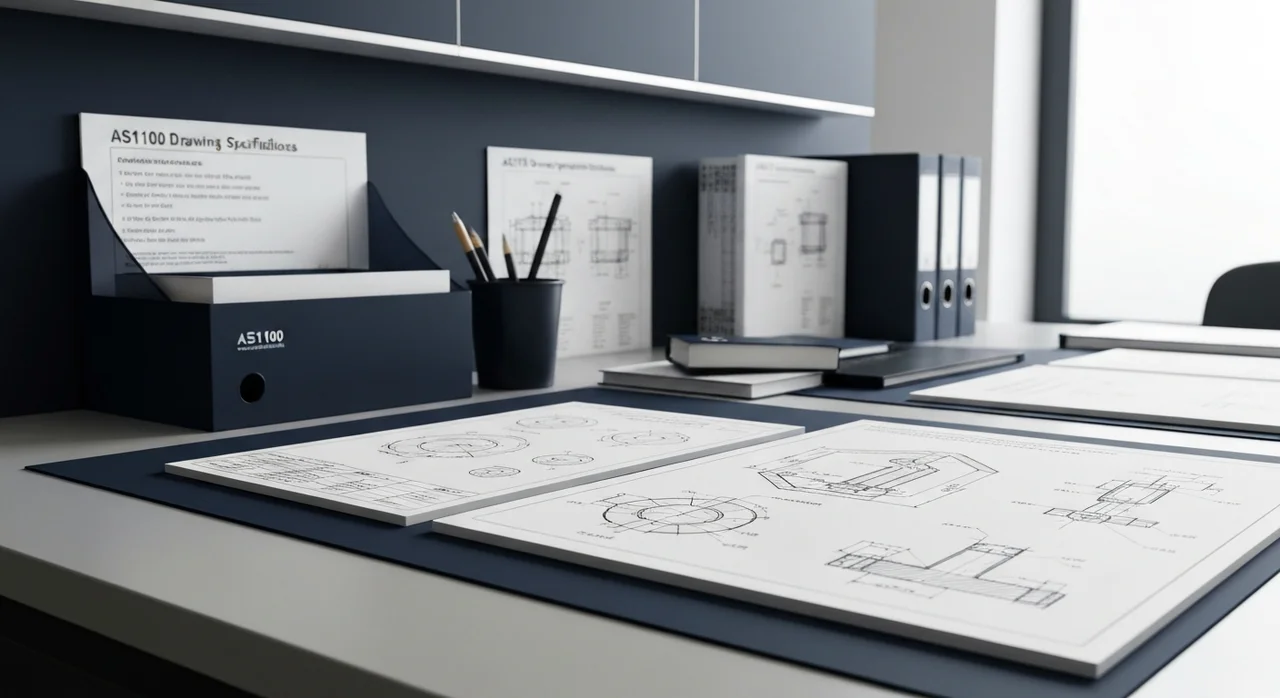
The AS 1100 series is the foundational standard for technical drawing in Australia. It governs how drawings are presented — line weights, projection methods, dimensioning, tolerancing, symbols, and sheet layout. Every CAD drawing produced for an Australian project should follow AS 1100 conventions unless the project specifies an alternative international standard (e.g. ISO).
Key parts of the AS 1100 series include:
- AS 1100.101 — General principles. Covers projection methods, scales, line types, lettering, and basic drawing conventions.
- AS 1100.201 — Mechanical engineering drawing. Specific conventions for mechanical components, threads, fasteners, and surface finish symbols.
- AS 1100.301 — Architectural drawing. Conventions for architectural plans, elevations, sections, and details.
- AS 1100.401 — Engineering survey and engineering survey design drawing.
- AS 1100.501 — Structural engineering drawing. Conventions for steel, concrete, and timber structural drawings.
If you’ve ever wondered why Australian engineering drawings have a particular look — third-angle projection, specific dimension styles, AS-format title blocks — that’s AS 1100 at work.
AS 4100 — Steel Structures
AS 4100 is the design standard for steel structures in Australia. It defines design rules for steel members, connections, and assemblies — covering everything from beams and columns to bolted and welded connections, fatigue, fire resistance, and seismic design.
For CAD drafting, AS 4100 affects:
- Connection design — Bolt sizes, hole patterns, weld specifications, and capacity checks documented on shop drawings
- Member sizing — Section properties referenced on structural drawings (UB, UC, RHS, SHS, CHS, PFC, etc.)
- Fabrication tolerances — Acceptable manufacturing tolerances called up on detailed drawings
Steel fabrication shop drawings are typically reviewed by the structural engineer of record against AS 4100 before fabrication can commence. The Australian Institute of Steel Construction (AISC) publishes detailing guides that complement AS 4100 and are widely used by fabricators and detailers.
AS 3600 — Concrete Structures
AS 3600 is the design standard for concrete structures, covering reinforced and prestressed concrete elements. For CAD drafting, AS 3600 governs how concrete members are detailed — reinforcement schedules, bar bending shapes, cover requirements, and cast-in items.
Drawings produced under AS 3600 typically include:
- Reinforcement layout drawings — Bar marks, sizes, spacings, and cover dimensions
- Bar bending schedules — Tabulated reinforcement quantities and bend shapes
- Concrete grade and cover specifications — Material strength and durability requirements
- Construction joint and lap details — Reinforcement continuity at joints
The Concrete Institute of Australia publishes detailing guides that complement AS 3600 for working drafters and engineers.
AS 1554 — Structural Steel Welding
AS 1554 is the welding standard for structural steel. It covers weld procedures, weld symbols, inspection requirements, and welder qualification. For CAD drafting, the most relevant impact is on weld symbol notation on fabrication drawings.
Key parts:
- AS 1554.1 — Welding of steel structures (most common for general construction)
- AS 1554.5 — Welding of steel structures subject to high levels of fatigue loading
- AS 1554.7 — Welding of stainless steels for structural purposes
Weld symbols on AS-compliant drawings follow specific conventions for fillet welds, butt welds, and complete penetration welds — including weld size, length, and inspection category notations.
AS 1170 — Structural Design Actions
AS 1170 defines the loads and actions that structures must be designed to resist — dead loads, live loads, wind loads, snow loads, and earthquake loads. While AS 1170 is primarily a structural engineering standard rather than a drafting standard, it directly affects load notations on structural drawings.
- AS 1170.0 — General principles
- AS 1170.1 — Permanent, imposed and other actions (dead and live loads)
- AS 1170.2 — Wind actions
- AS 1170.4 — Earthquake actions in Australia
National Construction Code (NCC)
The National Construction Code (NCC) — formerly known as the Building Code of Australia (BCA) — is the over-arching technical code for building work in Australia. It is published by the Australian Building Codes Board (ABCB) and adopted as law by every state and territory.
The NCC is divided into:
- NCC Volume One — Building Code of Australia, Class 2 to Class 9 buildings (commercial, industrial, multi-residential)
- NCC Volume Two — Building Code of Australia, Class 1 and Class 10 buildings (single dwellings, sheds, garages)
- NCC Volume Three — Plumbing Code of Australia
The NCC references many Australian Standards as “deemed-to-satisfy” provisions. When a drawing complies with the relevant AS, it satisfies the corresponding NCC requirement. This is why standards compliance and NCC compliance are usually discussed together on Australian projects.
Other relevant standards by discipline
Architectural and building
- AS 1684 — Residential timber-framed construction
- AS 4055 — Wind loads for housing
- AS 1428 — Design for access and mobility (disability access)
- AS 2118 — Automatic fire sprinkler systems
Mechanical and HVAC
- AS 1668 — The use of ventilation and air conditioning in buildings
- AS 4254 — Ductwork for air-handling systems
Electrical
- AS/NZS 3000 — Electrical installations (the Wiring Rules)
- AS/NZS 3008 — Electrical installations — Selection of cables
Plumbing and hydraulic
- AS/NZS 3500 — Plumbing and drainage
- AS 2118 — Fire sprinkler systems
How Draftings Australia applies these standards
Every drawing we produce is prepared with the relevant Australian Standards in mind. Our team includes drafters and engineers familiar with the AS 1100 drawing conventions, the structural standards (AS 4100, AS 3600, AS 1170), welding requirements (AS 1554), and the National Construction Code.
When a project specifies particular standards or council requirements, we incorporate those into our drawing approach from the outset — title blocks, drawing conventions, materials specifications, and detail callouts. For projects that span multiple disciplines, we coordinate across the relevant standards to deliver an integrated drawing set.
If you have questions about how a specific Australian Standard applies to your project, our team is happy to discuss it. Standards compliance is foundational to what we do, and we treat it as a baseline rather than a feature.
Authoritative sources for Australian Standards
This page is a practical reference. For authoritative copies and current versions of any standard, always refer to the source:
- Standards Australia — Publisher of all AS and AS/NZS standards
- Australian Building Codes Board (NCC) — National Construction Code, free to view online
- Australian Institute of Steel Construction (AISC) — Steel detailing guides and AS 4100 supplements
- Concrete Institute of Australia — Concrete detailing references and AS 3600 supplements
- Engineers Australia — Professional engineering body
Standards are periodically revised. Always confirm the current version before relying on a specific clause for design or compliance purposes.
Need standards-compliant CAD drawings?
If your project requires drawings that comply with Australian Standards and the NCC, contact Draftings Australia for a free, no-obligation quote. Our Brisbane-based team delivers compliant CAD drafting across Australia — Brisbane, Sydney, Melbourne, Perth, and the Gold Coast.
📞 National: 1800 287 223
📧 info@draftings.com.au
Disclaimer: This page is a general reference and is not a substitute for professional engineering advice or for the standards themselves. Always refer to the current published version of any standard via Standards Australia or the relevant authority.