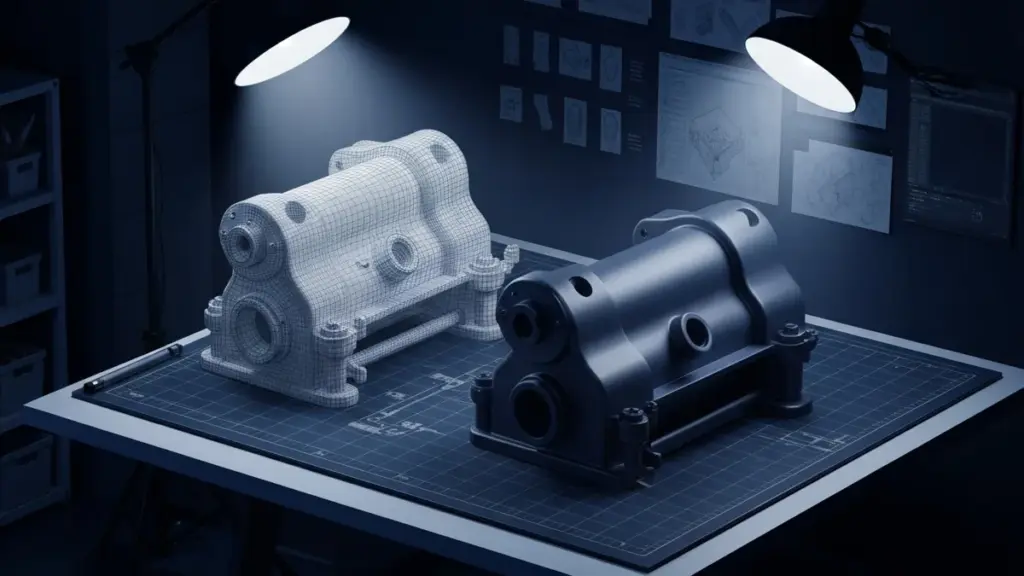
Most enquiries about “3D CAD modelling services” arrive with one of two confusions: either 3D modelling is treated as the same thing as 2D drafting with an extra dimension, or it’s conflated with 3D printing. They’re neither. This is what 3D CAD modelling actually delivers for a design or manufacturing project, and when it’s worth commissioning.
What a 3D CAD model is for
A 3D CAD model is a dimensionally accurate digital representation of a part or assembly. Unlike a 2D drawing — which documents a design — a 3D model is the design data: it drives manufacturing, simulation, clash detection, and the automatic generation of 2D drawings from a single source of truth.
That single-source property is the real value. Change the model and every derived drawing, section, and bill of materials updates with it. For projects with revisions — which is all of them — this removes an entire class of human error.
The three jobs 3D modelling does well
- Design validation before fabrication. Interferences, fit, and assembly order are visible in the model long before metal is cut. Catching a clash on screen costs minutes; catching it on the shop floor costs a re-run.
- Manufacturing-ready output. A correct model exports the formats fabricators and machinists actually use, and generates compliant 2D shop drawings to technical documentation standards from the same geometry.
- Communication. A rendered assembly tells a client, an installer, or an approver more in seconds than a stack of orthographic views.
When 3D is worth it — and when 2D is enough
Not every job needs a 3D model. A simple bracket detailed for a one-off fabrication may be faster and cheaper in 2D. 3D earns its cost when the part is geometrically complex, when it’s part of an assembly that must fit together, when the design will be revised, or when the same data needs to feed multiple downstream uses. The honest answer to “do I need 3D?” is “what happens to this design after you receive it?”
If the model has to be manufactured, simulated, or revised, 3D pays for itself. If it’s a standalone document, 2D may be the right call.
What 3D CAD Modelling Services Include
Professional 3D CAD modelling services cover more ground than “making a 3D version of the drawing”. A typical engagement includes parametric part and assembly modelling in SolidWorks, Inventor or Fusion 360 so the geometry can be edited by feature rather than rebuilt; drawing generation, because most 3D work still has to land as dimensioned 2D documentation a workshop can build from; file conversion between native and neutral formats (STEP, IGES, Parasolid) so your supplier chain can open what you send; and preparation for downstream uses — meshing for 3D printing, simplification for rendering, or clean-up for simulation. The deliverable is agreed up front: some clients need only a STEP file, others need the full native model with design tree intact.
How to Brief 3D CAD Modelling Services Well
The quality of a modelling job is set by the brief more than the modeller. State what the model is for — manufacture, visualisation, printing or analysis — because each pulls the modelling approach in a different direction; supply whatever geometry exists, from hand sketches and photos through to legacy 2D drawings; identify the dimensions that are critical versus nominal, so tolerance attention lands where it matters; and name the target software and version, since a model delivered in the wrong format costs a translation round-trip. Briefed this way, most single-part jobs turn around in days, and you avoid the most expensive failure mode in outsourced modelling: a beautiful model built for the wrong purpose.